Most AI tools sold to PMO leaders today position themselves as a single solution — install this platform, plug in your project data, and the AI will give your PMs whatever they need. The pitch is clean, the demos are tight, and the pricing model is built to make the decision feel obvious. It is also wrong. Not slightly wrong. Structurally wrong.
The structural problem is that PMOs do not have one source of project data. They have six or eight, and the data was never designed for AI consumption — it was designed for human consumption, by different teams, at different times, with different conventions. Timeline data lives in Smartsheet or MS Project. Application development tracking lives in Azure DevOps or Jira. Budget forecasts live in Excel. Budget actuals live in Power BI or Tableau. Scope documentation lives across SharePoint folders, Teams channels, Confluence spaces, and email threads. The single-solution AI vendor either ignores this — selling a tool that only works against the slice of data they already have — or papers over it with “integrations” that present as solutions but do not fix the underlying data problem.
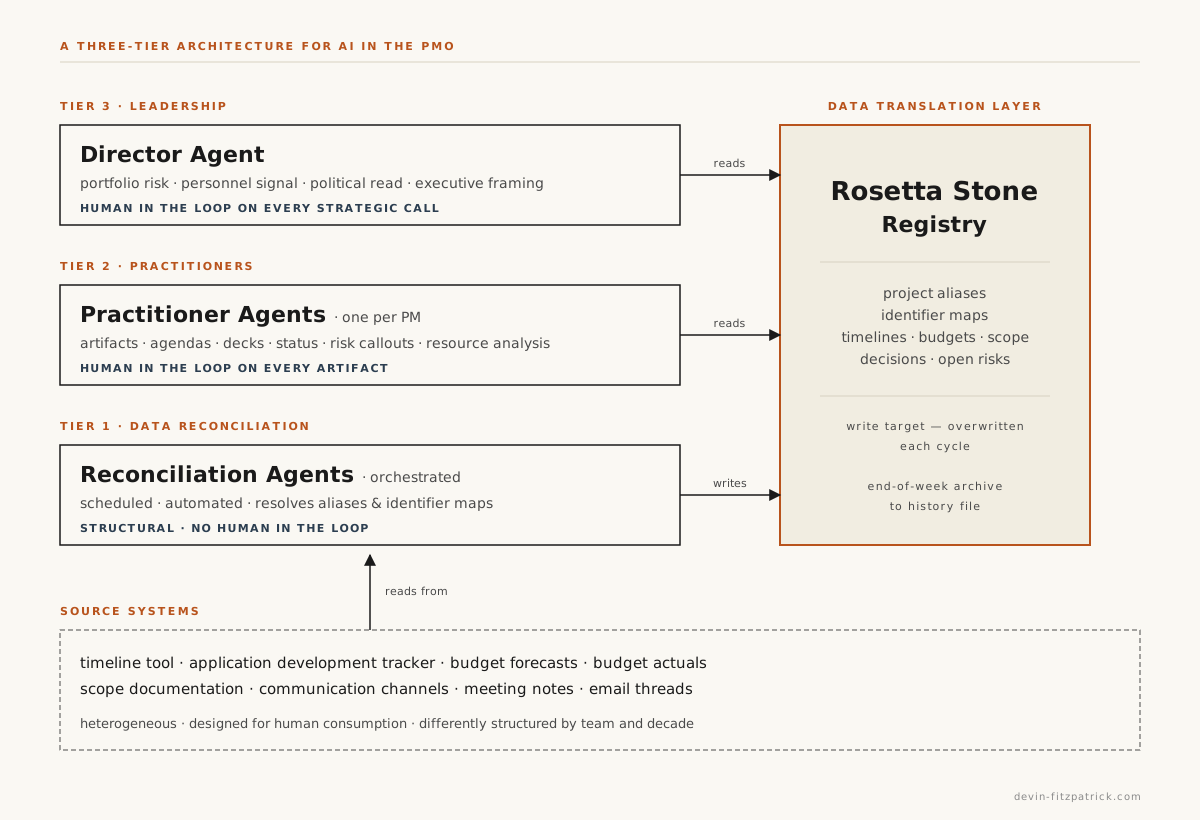
What I have built instead, and what I think is the right operating model for AI in the PMO, is a three-tier architecture. It is deliberately not a single tool. It is a layered system where each tier does a different job, and the layers are orchestrated rather than monolithic. This essay describes the operating model — not the specific implementation at any one company, but the pattern the implementation expresses.
The problem each tier exists to solve
Single-solution AI tools fail because they conflate three jobs that are actually distinct.
The first job is data reconciliation — taking heterogeneous data from systems that were never designed to talk to each other and producing a coherent, current view of what is happening across the portfolio. This is mostly a plumbing job. It is where the work has to start, because every other layer depends on it.
The second job is practitioner sense-making — giving each PM a working partner that can read the reconciled data, understand the context of their projects, and produce the artifacts and recommendations they need to do their job better. This layer is about leverage on individual practitioners.
The third job is portfolio-level judgment — giving the leader running the PMO a view that crosses individual projects, synthesizes risk and personnel signal, and supports decisions no individual PM is positioned to see. This layer is about strategic awareness.
When you try to do all three jobs in one tool, you do all three of them poorly. When you separate them into tiers and orchestrate between them, each tier can be designed for its actual job.
Tier 1: Data Reconciliation
The foundation tier is a set of agents whose only job is to read the source systems where project data actually lives and produce a reconciled view. In a typical PMO this means agents that touch the timeline tool, the application development tracker, the budget forecasting spreadsheets, the actuals reporting platform, the scope documentation system, and the communication channels where decisions and notes accumulate.
The reconciliation produces a single artifact — a registry I call the Rosetta Stone — that holds the canonical view of the portfolio. What each project is named, what it is also called (because every project has aliases), what its identifiers are in each source system, where its human-readable URLs point, where its machine-readable IDs resolve, what the current timeline says, what the budget shows, what the open risks are, what was decided last week.
Two design choices matter here. The first is that the registry is a write target, not a database — each reconciliation run overwrites the prior view, and a separate end-of-week archival process captures historical snapshots for trend analysis. This keeps the registry small, current, and easy for downstream agents to consume. The second is that aliases are first-class data in the registry, because the same project gets called different things in different systems, and any agent reasoning over the portfolio needs to be able to cross-reference.
This tier is automated. It runs on a schedule and is orchestrated by an automation layer that sequences the agents, handles failures, and manages the write to the registry. There is no PM in the loop at this layer. The data either reconciles or it does not, and when it does not, the system flags it.
Without this tier, every other layer is operating on partial or stale data. With it, every other layer can assume the registry is current and trustworthy. Most AI-for-PMO tools never actually solve this problem — they assume away the heterogeneous data reality, or they handle a fraction of it and call the rest someone else’s problem. The architecture starts here because nothing else works without it.
Tier 2: Practitioner Agents
The second tier is one agent per practitioner. Each PM has their own agent, and each agent has read access to the Rosetta Stone registry plus the communication context the PM operates in — email, meeting notes, channel messages, the surface where decisions get made informally.
The job of this tier is leverage. A practitioner agent reads the registry to know what is true about the projects right now, reads the communications layer to know what is being discussed and decided around them, and produces what the PM needs: meeting agendas, executive slide decks, status updates, schedule recommendations, resource allocation analysis, risk callouts. The skills are deliberately PM-shaped — these are the artifacts a PM produces in a typical week, accelerated by an agent that already knows the data.
The critical design choice at this layer is that each PM builds their own agent. There is a template and a set of starting instructions, but the agent gets configured by the practitioner around their own projects, their own clients, their own working style. This matters for two reasons. First, ownership — a practitioner who configures their agent uses it as a tool, while one handed an agent uses it as an obligation. Second, fit — PMs work differently from each other, and a single shared agent forces a homogenization that loses the value of practitioner judgment.
Practitioner agents can see across the full portfolio, not just their own projects. This is intentional. A PM running a client implementation benefits from being able to ask their agent about resource conflicts on a different PM’s project, because the answer affects their own planning. The portfolio is a shared surface.
What this tier does not do is replace the PM’s judgment. It accelerates the work of producing artifacts and surfaces signal the PM might miss. The decisions are still the PM’s. The relationship with the client is still the PM’s. The reading of organizational politics is still the PM’s. Human in the loop is not a slogan here — it is a structural requirement, because the work this tier supports is judgment work, and judgment work does not get delegated to a model.
Tier 3: Director Agent
The third tier is a single agent at the leadership layer. It has all the capabilities of the practitioner tier — registry access, communication context, artifact production — plus a set of tools specific to running a portfolio rather than running projects: portfolio risk synthesis, personnel sentiment, leadership context, situational awareness across the political surface of the organization.
The job of this tier is judgment support for decisions no individual practitioner is positioned to see. A PM running a project sees their slice clearly. The director running the portfolio needs to see the slice of every project simultaneously, plus the personnel layer, plus the political layer, plus the strategic frame the work is being delivered against. The director agent is the layer that makes that possible.
Concretely, the director agent supports decisions like which project to reprioritize when client pressure shifts, where to reassign capacity when a PM departs, when to escalate a risk to the executive sponsor, how to frame an executive readout so the strategic value is visible. These are the decisions where being one tier removed from the operational data — but having full visibility into it — produces better outcomes than either of the other layers could produce alone.
This tier sits closest to the human, because the decisions it supports are the highest-stakes and the most context-dependent. The director agent is a thought partner, not a delegate. It does not make decisions; it pressure-tests them, surfaces what might be missed, and produces the framing material that makes the decision legible to the people who need to act on it.
The orchestration spine
The three tiers are connected by an orchestration spine, not by direct integration. Tier 1 writes to the registry. Tier 2 and Tier 3 read from it. The communication context layer is shared. There is no chain where Tier 3 calls Tier 2 calls Tier 1 — that pattern produces brittle systems where a failure at one layer cascades.
The Rosetta Stone registry is the orchestration spine. It is the canonical reference shared across every tier and every consumer. Aliases are first-class. Identifiers map to both human-readable and machine-readable forms. The registry is the contract between layers, and the contract is what makes the system durable.
This design is also why the architecture survives a major platform releasing a new capability. New capabilities slot in as new agents or new tools at the appropriate tier; the registry stays the same; the orchestration stays the same. When a hyperscaler shipped a new agent feature recently, it slotted into the existing architecture without new plumbing — because the inputs it needed were already in the registry. That is what architectural durability looks like in a category that is moving this fast.
Where the human stays in the loop
Single-solution vendors talk about Human in the Loop as a marketing phrase. In this architecture it is a structural property.
At Tier 1, no human is in the loop, because the work is mechanical reconciliation. The system flags exceptions; humans address those.
At Tier 2, the human is in the loop on every decision the agent participates in — the agent produces material, the practitioner judges it, the practitioner acts on it. The agent never closes a decision loop on its own.
At Tier 3, the human is in the loop on every strategic call. The agent surfaces, frames, and pressure-tests, but the director decides.
The architecture works because each tier’s relationship to human judgment is appropriate to the work that tier is doing. Mechanical work is automated. Practitioner work is augmented. Strategic work is supported. Nothing critical is delegated.
Who this is for, and who this isn’t for
This operating model is for PMO leaders who are willing to build something layered rather than buy something packaged. It requires investment — in the data reconciliation work, in the practitioner training, in the orchestration design. It does not produce a fast win in the first thirty days. It produces compounding leverage over the first year.
It is not for PMO leaders looking for a vendor to point at when leadership asks “what are we doing about AI.” There are tools for that purpose. They will not produce the same result, and the gap between the two operating models is going to widen, not narrow, as the data moats across enterprises become the constraint that determines competitive advantage.
The market bet that AI will replace project management runs in one direction. The operating model in this essay runs in the opposite direction — that PMs become more central to value creation, not less, because AI handles the data aggregation and reconciliation that frees practitioners to operate higher up the cognitive stack. The architecture is what makes that frame operational.